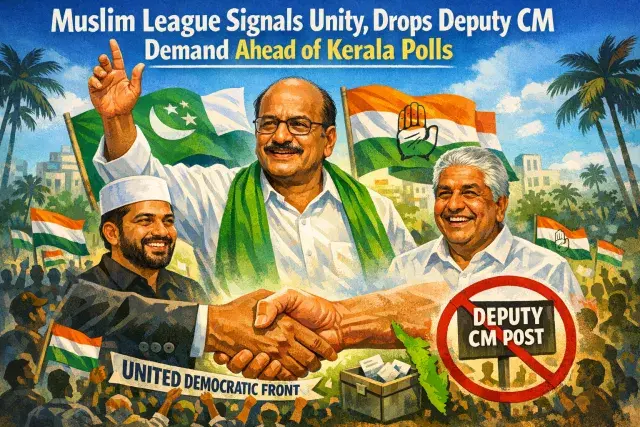
Muslim League Signals Unity, Drops Deputy CM Demand Ahead of Kerala Polls

Senior Indian Union Muslim League leader P K Kunhalikutty has declared with confidence that the United Democratic Front will return to power in Kerala, pledging full support for whichever candidate the Congress party selects as chief minister — and explicitly ruling out any demand for the deputy chief minister's post. The statement, made in Malappuram, signals a deliberate effort by the League to present the UDF as a disciplined, coalition-ready front at a politically charged moment. It also reflects a broader calculation: that coalition harmony, not portfolio negotiation, is the stronger electoral argument this time.
A Coalition Distancing Itself From Past Friction
Kunhalikutty's remarks carry the weight of institutional memory. Kerala's coalition politics has historically been marked by post-election bargaining over cabinet positions, deputy chief ministerial claims, and departmental allocations — friction that has repeatedly damaged the credibility of governing alliances. By preemptively withdrawing any claim to the deputy CM post, the League is attempting to reframe itself as a stabilising force rather than a pressure group within the UDF.
Munavvar Ali Shihab Thangal reinforced this position directly: the party considers itself eligible for the post by virtue of its electoral weight and constituency base, but will not raise a formal claim or allow the matter to become a source of dispute. The distinction between eligibility and demand is politically meaningful — it asserts the party's standing while declining to weaponise it.
The Seat Projection and What It Rests On
Kunhalikutty cited UDF opposition leader V D Satheesan's projection of securing 100 or more seats, framing it not as optimism but as analysis. He pointed to the accuracy of the front's internal assessments during the Nilambur by-election as evidence that the methodology is sound. He also noted that if the trend observed during the parliamentary elections holds, the 100-seat threshold becomes achievable — or even a floor rather than a ceiling.
For the League specifically, Kunhalikutty expressed hope in 27 seats, acknowledging earlier uncertainty in Punalur and Chelakkara but describing a shift in mood after observing activists' enthusiasm on the ground. Seat-level confidence communicated publicly serves a dual function: it reinforces morale within the organisation and signals to fence-sitting voters that the front is credible enough to form government.
Governance Urgency and the Critique of the Incumbent
Beyond the political arithmetic, Kunhalikutty's statement carried a pointed economic critique of the current Left Democratic Front government. He described the state treasury as empty and called for the chief minister and cabinet to be constituted swiftly once power is obtained, so that governance can begin without delay. His phrase — that running government is not like Aladdin's magic lamp, that money is required to generate money — is a direct indictment of what he characterised as fiscal mismanagement under the LDF.
He invoked the governance style of former chief minister Oommen Chandy as the standard to which Kerala should return. Chandy's tenure is associated by UDF supporters with a more accessible, people-facing administrative approach. Whether that framing resonates with the broader electorate will depend on how voters weigh the incumbent government's record against the UDF's alternative — but the reference anchors the front's electoral pitch in a specific, named model of governance rather than in abstract promises.
The League's Positioning on Identity and Representation
Shihab Thangal addressed the question of identity politics directly, stating that the party had not sought votes in the name of religion, while affirming that marginalised communities continue to place their trust in the League. This is a careful positioning: it distances the party from communal mobilisation while acknowledging its base, and it implicitly pushes back against any characterisation of the League as a purely religious-interest organisation.
For a party whose constituency overlaps significantly with Kerala's Muslim population — particularly in Malappuram and parts of Kozhikode — this framing serves both internal and external audiences. Internally, it reinforces a secular-democratic identity. Externally, it addresses criticisms that minority-interest parties distort coalition governance by pursuing narrow community agendas over broader public administration. Whether the electorate accepts that framing will be one of the more telling indicators when results come in.